You Have Gone Too Far!!!!
Korach and Performative Masculinity

Long before the first roundhouse kick was delivered on the front lawn of the White House, the phenomenon of hyper-masculinity had come to the fore. Much has been written about the so-called manosphere, the loose constellation of online spaces organized around male grievance, anxiety, and anger. At their most extreme, these spaces traffic in misogyny, fantasies of domination, and conspiracy theories including classic antisemitic tropes. But to gauge them only by their most toxic manifestations is to miss something important. Much of what fuels these communities begins with real pain. Many men experience loneliness, social isolation, confusion about changing expectations, and a profound uncertainty about what healthy masculinity looks like. They feel displaced, unseen, or ashamed of needing connection. Those struggles deserve to be taken seriously. Pain that is ignored does not disappear; more often, it becomes vulnerable to manipulation.
Surprisingly prescient, this week’s Torah reading Korach hinges on a similar dynamic. Korach was a high-born Levite who rallied a mob of supporters against the leadership of his cousins Moses and Aaron. His rebellion began with a charge against Moses: Rav lachem—“You have gone too far, taken too much for yourself” “All the community are holy, every one of them, and the Eternal is in their midst. Why then do you raise yourselves above the congregation of G*d?” The Torah does not present him as a cartoon villain. His grievance seems substantial, even high-minded.His challenge resonates because it contains real truth. People do feel overlooked, excluded, and alienated from structures of power. Communities and institutions do sometimes become self-protective. Yet Korach’s rebellion is dangerous because his words are an excuse not a cause.
The rabbis teach in Pirkei Avot, Ethics of our Ancestors, that the dispute of Korach and his gang is the prime example of a dispute not for the sake of heaven. They contrast this with the clashes between the sages Hillel and Shammai which exemplify a dispute motivated by search for truth and thus each side of the argument is preserved. That does not mean that Korach’s claims had no truth to them, but rather that he was motivated by ego and status, not fairness on behalf of others. Beneath “all the community are holy” lurkes the question: Why not me? Korach speaks in the language of equality, but clearly regards the elevated status of others as a personal humiliation.
Grievance can be morally clarifying. The danger lies in what grievance becomes when it fuses with wounded ego. Much of the manosphere presents itself as a movement aimed at restoring male dignity. Yet dignity often becomes confused with dominance. Strength is redefined as control. Respect becomes something extracted rather than earned. Vulnerability is framed as weakness, and relationships are recast as contests for power. The underlying message is simple and seductive: if you feel small, become bigger than someone else.
Our culture increasingly rewards that message. We live in an era that turns conflict into spectacle and dominance into entertainment. Even the idea of hosting a UFC fight at the White House feels symbolically revealing—not because of politics, but because of what the imagery communicates. Combat becomes not merely sport but cultural aspiration. Winners and losers, takedowns and submissions, conquest and humiliation become the metaphors through which strength is imagined. The crude remark aimed at a powerful woman by one of the victors was just the calling card. Masculinity becomes performative, measured by one’s ability to impose oneself, to win, to dominate, to refuse vulnerability or any limits.
The Torah offers a radically different vision of strength. The rabbis ask in Pirkei Avot, Who is strong? Their answer is counterintuitive: One who conquers their impulse. This is not the language of domination but of discipline, not hierarchy but self-mastery. Strength in Jewish tradition goes hand in hand with responsibility.
The rabbis ask a second question: Who is honored? Again, their answer overturns conventional assumptions: One who honors others. Honor must be through relationships built through mutual respect. One of the deepest spiritual errors shared by Korach and by contemporary grievance culture is assuming that dignity is scarce. If someone else possesses honor, power, influence, or recognition, then there must be less available for me. Their elevation becomes my diminishment. But holiness is not a zero-sum game.
This is where Moses becomes an important counter-model. The Torah describes him as anav me’od, exceedingly humble. Humility here should not be mistaken for weakness. Moses confronts Pharaoh, challenges G*d, shepherds a stiff-necked people through the wilderness, and is not immune to losing his temper and lashing out. But he does so without turning leadership into performance. He is powerful without swagger. He exercises authority without becoming addicted to dominance. He embodies a form of strength that has become deeply countercultural.
That may be one of Torah’s most important contributions to contemporary conversations about masculinity. Our culture often offers men two inadequate models. One is the older ideal rooted in domination, emotional suppression, and rigid hierarchy. The other sometimes struggles to articulate what healthy masculine strength positively looks like. Torah refuses both. It does not ask men to become smaller, nor does it ask them to become harder. It asks them to become deeper.
Korach asks, What can I have for myself? Moses asks, What can I be for myself and others? These are not merely different questions; they reflect entirely different moral universes.
Perhaps that is Korach’s enduring relevance. The story is not simply about rebellion versus obedience, nor about suppressing dissent. Sometimes institutions must indeed be challenged. Sometimes protest is necessary. The deeper challenge of Korach is to examine the soul beneath our protest. Are we seeking justice, or simply seeking elevation? Is our struggle truly for the sake of heaven, or is it for the sake of ego?
Every generation seems to produce its own version of Korach. All of us know the experience of feeling unseen, overlooked, or underappreciated. The question is not whether we will experience hurt. We will. The question is what we do with that hurt. Does it become resentment, or can it become responsibility? Does pain trap us in comparison and hierarchy, or can it deepen our capacity to recognize the struggles of others?
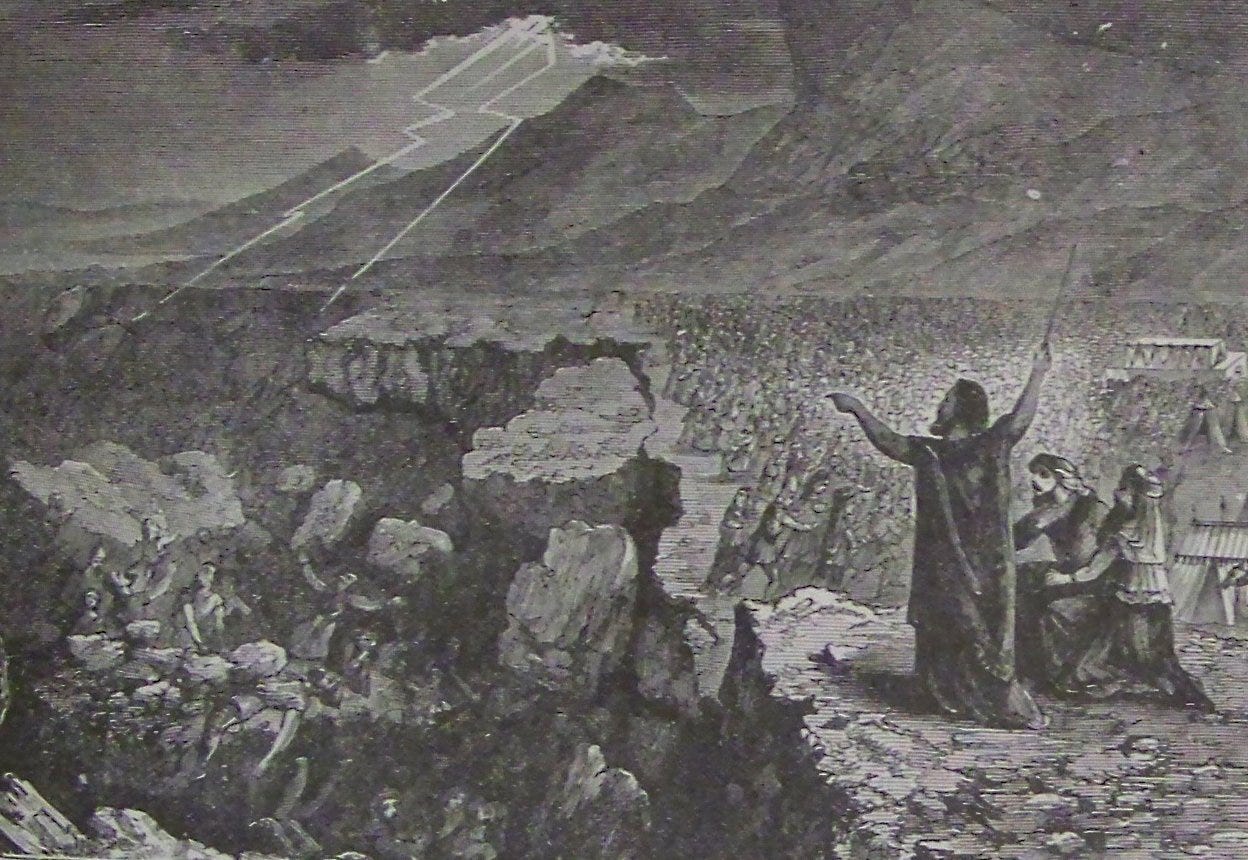
In the end, things end badly for Korach and his crew. The earth swallows them whole, which though graphic and supernatural, feels on point. Envy, honor, and grievance can swallow a person from within. They create a world in which every interaction becomes hierarchical and every relationship becomes competitive. That is its own kind of abyss.
Korach ultimately leaves us with a question that feels as urgent now as it did in the wilderness: When we challenge authority, when we seek dignity, when we struggle to find our place, what is driving us beneath the surface? Torah’s response to the crisis of masculinity may not be a call for softer men or harder men, but for men comfortable in their own skin. Men who find holiness side by side with each other without need to perform and with human beings of every type and gender without need to dominate and belittle. The Torah invites us to be human beings who understand that dignity is not built by standing above others, but by learning how to stand responsibly before them.