Honarary
Reflections Dedicated to the Memory of Matthew Eisenfeld and Sara Duker for their Thirtieth Yahrtzeit

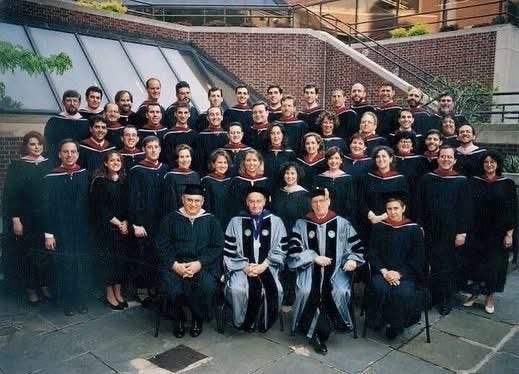
This Monday, my rabbinical school classmates and I will receive an honorary Doctor of Divinity degree from the Jewish Theological Seminary, marking twenty-five years since we were ordained as rabbis.
“Honorary” is a tricky word.
At its root an honor is something to be earned. An honorary degree, though, seems like the opposite. It is given not as a credential achieved through coursework or examination, but as a voluntary accolade. An act of appreciation rather than attainment.
When I was in rabbinical school, my plan had been to pursue a doctorate, a Phd in Jewish philosophy. Instead, I found myself drawn to the pulpit, to being a congregational Rabbi with a very different point of engagement with the questions at the heart of Jewish life. These 25 years have been incredibly fulfilling, almost two thirds of them at Gesher L’ Torah in Alpharetta Georgia outside Atlanta. Here I have had the irreplaceable honor of serving as a spiritual leader and part of the lives of people in their everyday life and life shaping moments. While imagining having pursued an academic career is almost impossible, the honor of receiving this doctorate is also a reminder of the path not taken.
However, this day evokes something much deeper, an ache that will be felt by our entire cohort. One of our classmates, Matt Eisenfeld along with his beloved Sara Duker, was murdered by terrorists during our year in Israel before he could be ordained, let alone before any of us could imagine standing together twenty-five years later. Along with them, twenty-six lives were taken from the world - futures erased, celebrations unrealized.
While it is of no consequence to ask what could have been about my own choices, it feels weighty to think about what Matt and Sara could have accomplished had they not been cruelly taken from the world three decades ago. What Matt would be celebrating had he lived to not only be ordained as a Rabbi but to stand together with Sara, looking back at a quarter century of serving the Jewish people as a Rabbi. Matt was a deep thinker and at the same time an impactful doer. He brought a joyous spark to the world around him and burned with an uncompromising passion to serve G*d in all that he undertook. What a robbery perpetrated on the world by those who murdered him and Sara and all 26 of the people on that bus! Every member of my class will gather with a shard in our hearts that nothing will remove. And yet, we will celebrate and be celebrated for reaching this occasion. In the words of the Shehechiyanu blessing - we will give thanks for being kept alive, for being present, and for arriving at this moment.
In Latin, a degree such as we are receiving is called honoris causa - “for the sake of honor” and in Hebrew this translates to l’shem kavod. And kavod is an even trickier word than honor.
The Hebrew root suggests weight and substance - something with gravitas, to move back over to Latin. The quintessential kavod in the Torah is kavod adonai, the Divine Glory, a palpable manifestation of G*d’s presence. When the kavod fills the Sanctuary in its totality, even Moses is not able to enter.
Yet the same word also describes the honor we give to parents, teachers, and one another - kavod habriut, honor to our fellow creatures. In the language of kavod, divine glory and human dignity overlap.
The final lines of Pirkei Avot assert that G*d forms all of creation solely for G*d’s own kavod. As the Orthodox philosopher Rav Moshe Shapira z"l points out, this creates a theological puzzle: If an honor is only an honor if it is freely given, how can G*d create for the sake of G*d’s own kavod?
Honor imposed upon oneself is hollow; kavod requires relationship.What G*d seeks is not the glory but one capable of choosing to give it. Creation is an act of divine vulnerability - G*d bringing into being creatures capable of freely recognizing and responding to divine presence. Perhaps this is what it means to say that G*d creates for G*d’s own kavod. Not a demand for praise, but an invitation - the creation of a world in which recognition is possible, in which honor emerges through relationship rather than coercion.
Kavod goes from being an objective measurement of worth to an affirmation of relationship. True kavod emerges when presence becomes undeniable - when we choose to recognize the weight of one’s life, one’s story, one’s journey.
This idea feels especially present for me in receiving our honorary honor on the occasion of our dear friends’ yahrzeit. Both Matt and Sara embodied the Jewish principle of not only not chasing honor but not even peeking over your shoulder to see if it is chasing you. Where they were and heartbreakingly where they never had the chance to be could only be a place filled with kavod habriut, deep regard for all creation and kavod adonai, the exaltation of G*d’s presence.
This week, as my classmates and I stand together, the honor we receive will feel both light and heavy. Light in its ceremonial form, heavy with gratitude and the awareness of the blessing of our twenty-five years serving the Jewish people. Heavy with the memory of those who are absent and the honor it was to have had them in our life.
Kavod, after all, is weight. And sometimes the greatest honor is not what we have earned, but what we carry.
May my entire class be uplifted by this honor and may we serve as a blessing as the memory of our dear Matt and Sara will ever be a blessing to all they knew, all they touched and the entire world.
כל הכבוד!