From Never Forget to Always Remember

Recently the US Holocaust Museum laid down a marker criticizing the invoking of Anne Frank’s memory in relation to children who are hiding in their houses out of fear of deportation. When reduced to a comparison between what Anne Frank hid from, an insatiable machine of ethnic cleansing and execution, and the circumstances of these children hiding, there is a gigantic chasm. As there is between the scale and totality of the Holocaust and almost any other act of brutality. The targeting of Jews for being Jews, regardless of any consideration of background, practice, public identity or criminality was without exception and without remediation. Anne Frank was only one of the multitude whose only hope was to hide and one of millions who could not escape the fate decreed for her by Adolf Hitler and his willing executioners.
Yet, the most prominent voices that have emerged out of that period of unfathomable suffering, have always insisted that the lessons of the Holocaust must not only be an exercise in remembrance but an ethical charge that applies to every person in every age. Perhaps the most well-known and salient of these voices belongs to Elie Wiesel, a survivor of Auschwitz and Buchenwald who produced in his writing, oratory and actions a body of work that gave language and purpose to the ongoing legacy of the Shoah.
In one of his annual speeches on the occasion of the liberation of Auschwitz, International Holocaust Remembrance Day, he challenged:
“But is remembrance enough? What does one do with the memory of agony and suffering? Memory has its own language, its own texture, its own secret melody, its own archeology and its own limitations: it too can be wounded, stolen and shamed; but it is up to us to rescue it and save it from becoming cheap, banal, and sterile…To remember means to lend an ethical dimension to all endeavors and aspirations.”
Today, on International Holocaust Remembrance day the tension between remembering the Holocaust meaningfully and cheapening its legacy remains as intense as ever. Is it banal to invoke Anne Frank to make a point about children hiding in fear of being dragged away by federal agents? Or is the memory of the Shoah sterile if we don’t bring it to bear in the face of injustice?
In my experience both as someone learning about and someone who teaches about the Holocaust, an emphasis has been on teaching what it means to be an upstander rather than a bystander. While there are certainly egregious misuses of our story and those who erase the Jews or minimize the actions of the Nazis, most of the time that the imagery of Anne Frank or the shadow of state-sanctioned bigotry are invoked, the lesson is not primarily about the aggressor or the intended victim, but rather the one who refuses to join, refuses to ignore, refuses to comply.
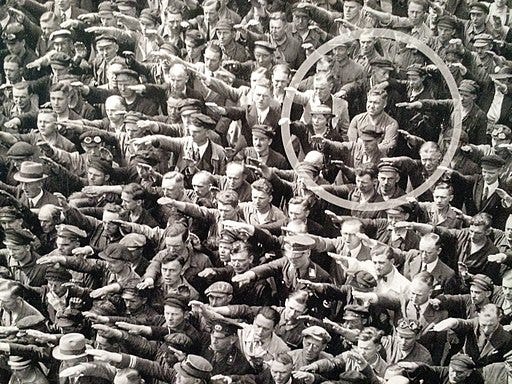
The image that comes to mind is the famous one of the assembly of Nazi party members at the docks, greeting the launch of the German vessel Horst Wessel with raised arms and a unified cry of Sieg Heil. One person in that picture, a man named August Landmesser stands with arms crossed and no trace of compliance on his scowling face. The cause that he is courageously dissenting from is one of surpassing evil and the fate he will share with the Jews and other enemies of the Nazis around him is more dire. Yet, his example of refusing and resisting is one that resonates immediately.
Again in the words of Wiesel:
“There may be times when we are powerless to prevent injustice, but there must never be a time when we fail to protest…. We may be powerless to open all the jails and free all the prisoners, but by declaring our solidarity with one prisoner, we indict all jailers”
We must be careful not to water down the record of the Holocaust by comparing its atrocities too easily with other injustices. And, at the very same time, must heed Wiesel’s warning that we not sterilize our commemoration of the Holocaust by failing to bring its ethical dimensions to bear in our own attitudes and actions.
The sacred charge “Never Again” begins with the promise of “Never Forget” and “Never Forget” is not about the past but about the moment. Never forget to resist injustice. Never forget to assist the vulnerable. Never forget that indifference is not an option. Never forget that it is better that we speak about the legacy of the Shoah in the face of inhumanity than let it be consigned to history or worse lost completely. Only then can “Never Forget” become “Always Remember”